Why Reading Two Books on One Topic Can Change Your Understanding
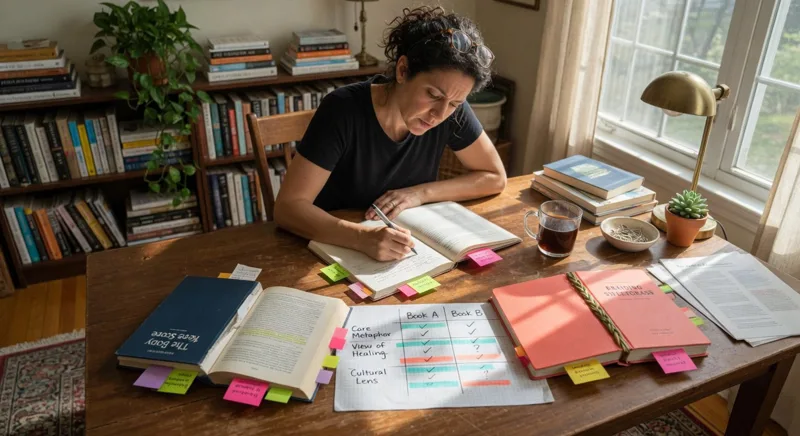
Why reading two books on one topic can change your understanding comes down to perspective. One book may introduce the main ideas, while another adds context, challenges assumptions, and reveals details you would otherwise miss. Together, they can turn basic knowledge into deeper, more flexible thinking.
One Book Gives You a Starting Point—Two Give You Context
Most books present a subject through a particular lens. The author chooses which evidence to emphasize, which examples to include, and how to organize the argument. Even an excellent book cannot cover every interpretation, historical detail, or practical application.
Reading a second book on the same topic allows you to compare those choices. You may discover that two experts explain the same event differently, use different definitions, or reach different conclusions from similar evidence.
This comparison does not automatically make one author right and the other wrong. Instead, it gives you a wider mental map of the subject.
How Two Books Build a More Complete Mental Model
A mental model is the framework you use to understand how ideas connect. Reading one book can create a useful model, but it may also leave gaps. A second book can fill those gaps by adding terminology, examples, opposing explanations, or practical detail.
For example, someone studying personal finance might read one book focused on budgeting and another about investing. The first explains cash flow and saving habits; the second explores risk, asset allocation, and long-term growth. The subject becomes more useful because the ideas connect.
The same principle applies to history, psychology, business, science, health, and professional education. Different books often illuminate different layers of the same topic.
Reading Different Perspectives Reduces Blind Spots
People naturally notice information that supports what they already believe. This tendency, known as confirmation bias, can cause readers to overlook evidence that challenges their assumptions.[2][4]
Choosing a second book with a different approach is a practical way to test your first impression. You might select:
- A book written by a different author or school of thought
- A newer book that includes updated research
- A practical guide after reading a theoretical work
- A beginner-friendly explanation followed by an advanced text
- A book that directly challenges the first author’s conclusions
The goal is not to create confusion. It is to ask better questions: What does each author assume? Which claims are supported by evidence? Where do their explanations overlap, and where do they diverge?
Comparison Improves Critical Thinking
Reading two books on one topic turns reading into an active investigation. Rather than simply accepting a conclusion, you evaluate arguments, identify evidence, and consider competing explanations.
Research on multiple-document comprehension suggests that understanding several sources with different perspectives is connected to critical-thinking and hypothesis-testing skills.[5] That matters because real-world decisions rarely depend on one perfectly complete source.
When comparing books, look closely at:
- The author’s credentials and intended audience
- The quality and age of the evidence
- Whether claims are supported by research or anecdotes
- The definitions used for important terms
- What information may have been omitted
- Whether the author acknowledges limitations or uncertainty
This approach helps you distinguish a persuasive writing style from a strong argument.
Why the Second Book Often Creates the Biggest Breakthrough
The first book usually gives you vocabulary. The second gives you comparison points. Once you understand the basic terms, you can recognize connections and contradictions that were invisible before.
This is similar to learning a language. The first exposure introduces words and grammar, while repeated encounters in different contexts make the meaning more permanent. Learning science also supports active recall—the practice of retrieving information from memory—as an effective way to strengthen learning.[1][3]
After finishing the first book, try to summarize its main ideas from memory before beginning the second. Then ask how the second book confirms, expands, or revises that summary. This simple process turns passive reading into deeper learning.
A Simple Two-Book Reading Strategy
- Choose books with a meaningful contrast. Avoid selecting two books that repeat the same content word for word.
- Read the first book for structure. Identify its central argument, key terms, and most important examples.
- Write a short summary from memory. Note what you understand and what remains unclear.
- Read the second book actively. Mark ideas that support or challenge the first book.
- Create a comparison table. Record each author’s claims, evidence, assumptions, and conclusions.
- Form your own explanation. Combine the strongest insights while preserving important disagreements.
| Reading goal | Helpful second book |
|---|---|
| Understand basic concepts | An introductory or visual guide |
| Evaluate competing ideas | A book from a contrasting viewpoint |
| Apply knowledge | A practical or case-study-based book |
| Update older information | A recent research-based title |
| Develop expertise | An advanced academic or professional work |
When Reading Two Books Is Not Enough
Two books can deepen understanding, but they are not automatically reliable simply because they are books. Both may repeat the same outdated claim, depend on weak evidence, or share the same bias.
For controversial, technical, or rapidly changing topics, add primary research, reputable institutions, professional standards, or expert interviews. Multiple sources are most valuable when they are genuinely independent and transparent about their evidence.
Conclusion: Read Across Perspectives, Not Just Pages
Why reading two books on one topic can change your understanding is simple: comparison reveals what a single perspective hides. The first book may provide a foundation, while the second adds contrast, context, and critical distance.
When you read actively, test assumptions, retrieve ideas from memory, and compare evidence, you do more than finish two books. You build a stronger mental model—one that is more nuanced, adaptable, and useful in real life.