How to Turn a Favorite Song Into a Language Lesson
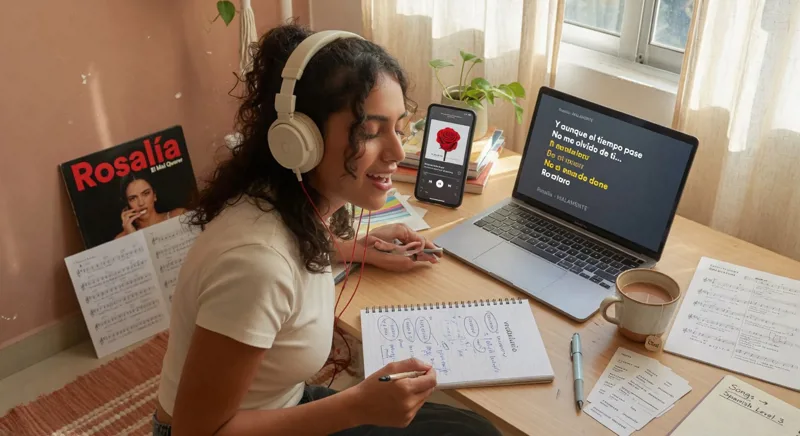
Want to make language learning more memorable? How to turn a favorite song into a language lesson is simple: use music to practice listening, vocabulary, pronunciation, grammar, and speaking—all through a song you already enjoy.
Why Songs Work So Well for Language Learning
Songs combine repetition, rhythm, emotion, and context. That combination helps learners remember words and phrases more naturally than isolated vocabulary lists. Music can also make practice feel less stressful, which encourages you to listen and speak more often.
A well-chosen song exposes you to authentic expressions, connected speech, pronunciation patterns, and cultural references. Repeated listening can strengthen vocabulary retention while singing along gives your mouth practice producing unfamiliar sounds.[1]
Step 1: Choose the Right Song
The best song for a language lesson is not necessarily the most complex one. Choose a track that is enjoyable, reasonably clear, and appropriate for your current level.
- Beginner learners: Choose slower songs with repeated lines and familiar topics.
- Intermediate learners: Try songs with everyday phrases, storytelling, and moderate speed.
- Advanced learners: Explore figurative language, regional accents, idioms, and dense lyrics.
Start with a song that has a strong chorus. Repeated lines make it easier to recognize new vocabulary and notice how words sound when sung. Avoid tracks where the vocals are heavily distorted or where slang makes most of the lyrics difficult to understand.
Step 2: Listen Without Reading the Lyrics
Play the song once without looking at the lyrics. Focus on the general meaning rather than trying to understand every word.
Ask yourself:
- What is the song about?
- What emotions does it express?
- Which words or phrases can you recognize?
- Where does the singer pause or repeat a phrase?
This first listening activity builds listening comprehension and gives you a realistic sense of what you already understand. Do not worry if some words sound unclear. Sung language often includes reductions, linking, and unusual stress patterns.
Step 3: Read the Lyrics and Build a Vocabulary List
Next, read the lyrics while listening again. Many music services display synchronized lyrics, but a reliable transcript is helpful for careful study. Write down useful words, expressions, and phrases rather than copying every unfamiliar term.
Organize your notes into practical categories:
- New vocabulary: individual words that appear repeatedly
- Collocations: words commonly used together
- Idioms: expressions whose meaning is not completely literal
- Grammar patterns: useful sentence structures
- Pronunciation features: reduced or linked sounds
For each new word, write the meaning, pronunciation, and an original example sentence. This turns passive recognition into active vocabulary practice.
Step 4: Notice Grammar in Context
Songs can make grammar easier to remember because you encounter it inside a meaningful message. Look for verb tenses, contractions, questions, negatives, conditionals, and word order.
For example, identify:
- Past-tense verbs used to tell a story
- Future forms used to express plans or predictions
- Modal verbs used for possibility or advice
- Contractions used in informal conversation
- Repeated sentence patterns in the chorus
Then rewrite one or two lines using your own information. This small exercise helps transfer grammar from the song into everyday communication.
Step 5: Practice Pronunciation and Connected Speech
Choose a short line and listen carefully several times. Pay attention to syllable stress, vowel sounds, rhythm, and word endings. Notice whether the singer connects words or reduces unstressed sounds.
Try this three-stage pronunciation exercise:
- Read the line slowly and clearly.
- Speak it at the song’s natural rhythm.
- Sing or shadow the line immediately after the singer.
Shadowing means copying the speaker or singer as closely as possible, including pauses and intonation. It is useful for improving speaking fluency, listening accuracy, and confidence. Remember that singing pronunciation may differ from ordinary speech, so use the song as practice—not as the only pronunciation model.
Step 6: Turn the Lyrics Into Active Practice
Once you understand the song, move beyond listening. Cover selected words in the lyrics and try to fill them in while the song plays. This creates a simple listening cloze activity.
You can also:
- Summarize each verse in your own words.
- Use five new words in a short paragraph.
- Discuss the song’s message with a language partner.
- Translate a short section, then compare meanings.
- Record yourself singing or speaking one verse.
These activities transform music from passive entertainment into a complete language lesson covering vocabulary, listening, reading, pronunciation, writing, and speaking.
A Simple 20-Minute Song Lesson Plan
| Time | Activity | Skill |
|---|---|---|
| 3 minutes | Listen without lyrics | Listening comprehension |
| 5 minutes | Read and mark useful phrases | Vocabulary and reading |
| 4 minutes | Study one grammar pattern | Grammar |
| 5 minutes | Shadow a short section | Pronunciation and speaking |
| 3 minutes | Write or discuss the song’s message | Active language use |
Common Mistakes to Avoid
Do not try to study every word in one song. Choose a manageable number of expressions and review them later. Avoid assuming that every lyric follows formal grammar; songs often bend language for rhythm, rhyme, or artistic effect.
It is also wise to check unfamiliar translations in a trusted dictionary. Lyrics may contain slang, cultural references, or metaphors that require additional context. If you use music in a classroom or publish lyric-based materials, follow applicable copyright rules and use authorized sources.
Make Music Part of Your Language Routine
The most effective approach is consistency. Choose one song each week, revisit its vocabulary, and gradually add new tracks from different artists or regions. Over time, you will hear repeated expressions, recognize connected speech more easily, and become more comfortable with natural pronunciation.
Learning a language through music works because it connects study with emotion and enjoyment. By listening actively, examining lyrics, practicing pronunciation, and using new expressions in your own sentences, you can turn a favorite song into a memorable, practical language lesson.