How to Make Flashcards That Ask Useful Questions
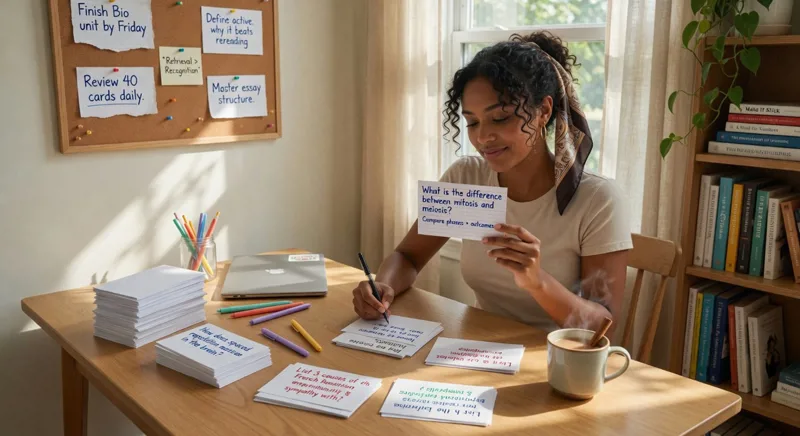
Learning how to make flashcards that ask useful questions can transform ordinary notes into powerful study tools. The best cards do more than display facts: they make you retrieve, explain, compare, and apply information before revealing the answer.
What Makes a Flashcard Question Useful?
A useful flashcard question has one clear purpose. It asks you to produce an answer from memory rather than recognize information you have already seen. This process, called active recall or retrieval practice, helps make knowledge easier to access later.
Strong flashcards are also specific enough to grade. If a question is so broad that almost any answer seems acceptable, you cannot tell whether you truly understand the topic.
- Focused: It tests one main idea or decision.
- Clear: The wording leaves little room for confusion.
- Retrievable: You must recall the answer before seeing it.
- Checkable: The answer shows exactly what counts as correct.
- Relevant: It supports a learning goal, exam objective, or practical skill.
Start With a Learning Goal
Before writing a question, identify what you need to know or do. A learning goal might involve defining a term, explaining a process, identifying a structure, solving a problem, or choosing between similar concepts.
For example, instead of copying a textbook paragraph about photosynthesis, turn the material into several targeted goals:
- Define photosynthesis.
- Identify where the light-dependent reactions occur.
- Explain how light energy becomes chemical energy.
- Compare the roles of chlorophyll and glucose.
Breaking a large subject into smaller, testable units makes flashcard creation faster and improves study efficiency.
Use Question Formats That Require Real Thinking
Definition questions
Definition cards work well for essential vocabulary, especially when the answer is short and precise.
Weak: What is osmosis?
Stronger: What movement of water across a selectively permeable membrane is driven by differences in solute concentration?
The stronger version includes enough context to make the question meaningful while still requiring recall.
Explanation questions
Use “why” and “how” questions when you need to understand relationships rather than memorize isolated facts.
- Why does increasing temperature usually speed up a chemical reaction?
- How does the immune system identify a foreign antigen?
- Why did this historical event lead to political change?
Keep the expected response manageable. If the answer requires an entire essay, divide it into several cards.
Comparison questions
Comparison flashcards are excellent for avoiding confusion between similar terms, theories, formulas, or processes.
- How are mitosis and meiosis different?
- What is the difference between correlation and causation?
- When should you use a dependent clause instead of an independent clause?
Ask for the most important distinction first. You can create additional cards for examples, exceptions, and applications.
Application questions
Application cards test whether you can use knowledge in a new situation. They are especially valuable for mathematics, science, medicine, law, coding, and professional exams.
Example: A patient has symptoms X and Y. Which physiological process could explain them, and why?
For a math topic, present the problem without immediately naming the formula. This tests recognition of the method as well as calculation.
Sequence and process questions
For procedures, ask learners to recall the steps or predict what happens next.
- What is the first step in the scientific method?
- What happens after DNA is transcribed into messenger RNA?
- Which step follows authentication in this security process?
Use separate cards for complicated processes so that one forgotten step does not make the entire card impossible to grade.
Keep One Main Idea Per Card
A common flashcard mistake is putting an entire lecture on one card. This creates a “knowledge pileup”: you may remember some details while missing others, making it difficult to rate your performance.
Instead of asking, “Explain the causes, events, and effects of the Industrial Revolution,” create focused questions:
- What economic conditions helped initiate the Industrial Revolution?
- Which major industries expanded first?
- What social changes followed industrialization?
This approach is sometimes called atomic flashcard design. Each card should be small enough to answer confidently but meaningful enough to support understanding.
Write the Answer Before You Finalize the Card
Write the question first, then create a concise answer. A good answer should include the essential information without unnecessary paragraphs.
For longer responses, use bullet points, examples, or a brief explanation. When studying, say the answer aloud or write it down rather than silently recognizing it. Retrieval practice is more effective when you make an observable attempt and then check your feedback.
Improve Weak Flashcards
Review every card with these questions:
- Is there only one main task?
- Could the question have multiple correct answers?
- Is the answer short enough to evaluate?
- Does the card test understanding rather than copying?
- Would an example or comparison make it clearer?
Delete cards that test trivial details unless those details are genuinely important. A smaller, carefully written deck is usually more useful than hundreds of vague cards.
Use Spaced Repetition Correctly
Flashcards work best when you revisit them across multiple study sessions. After attempting a card, check the answer immediately. If you were wrong, study the correct response and test yourself again later. Cards you miss should return more often, while confidently recalled cards can be reviewed at longer intervals.
Do not flip a card instantly and label it “easy” because the answer looked familiar. Pause, retrieve the answer, and explain it in your own words. Familiarity is not the same as mastery.
Final Checklist for Better Flashcards
- Choose one learning objective.
- Turn it into a specific question.
- Use active recall instead of simple recognition.
- Keep one main idea on each card.
- Add context, comparisons, or examples when useful.
- Write a concise, accurate answer.
- Test yourself before revealing the answer.
- Review difficult cards with spaced repetition.
The best flashcards are not miniature textbook pages. They are carefully designed prompts that make your brain do useful work. When each question is focused, answerable, and connected to a real learning goal, your flashcard deck becomes more than a memorization aid—it becomes a practical system for building durable understanding.