The Vocabulary Notebook That Includes Situations Instead of Just Words
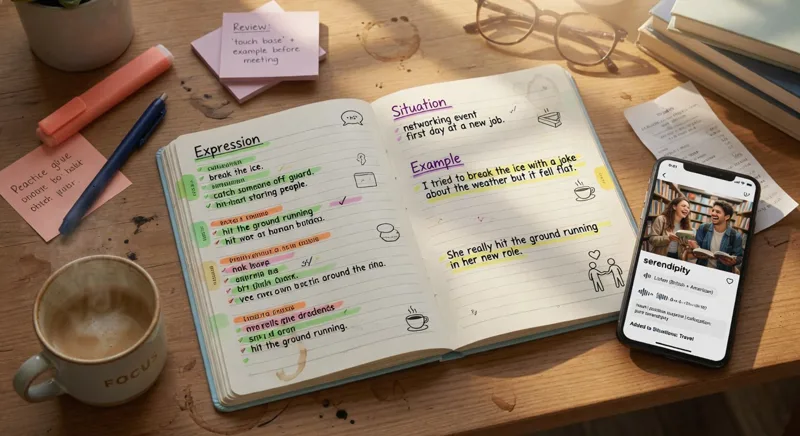
Most vocabulary notebooks collect translations. A better approach records situations, collocations, sentence patterns, and personal examples—so you learn how words actually work in real communication, not just what they mean in isolation.
Why a Traditional Word List Often Fails
Writing “appointment = cita” may help you recognize a word, but recognition is only the first step. When you need to speak, you must also know which verbs, prepositions, tones, and sentence structures naturally accompany it.
For example, English speakers usually say:
- make an appointment
- schedule an appointment
- cancel an appointment
- reschedule an appointment
A vocabulary notebook that includes situations instead of just words captures these useful combinations. This makes it easier to retrieve language quickly during a conversation, email, class, interview, or trip.
Collocations—words that commonly appear together—are particularly valuable because natural fluency depends on using familiar word combinations, not assembling every sentence one word at a time.[3]
What Should Go in a Situational Vocabulary Notebook?
The goal is not to write a long dictionary definition for every word. Instead, create a compact record that answers one practical question: When, where, and how would I use this expression?
1. The Word or Phrase
Record the vocabulary item clearly, including its part of speech when useful. Phrases are often more helpful than individual words.
Instead of writing “rest,” write “take a rest” or “get some rest.” This approach reflects how language is actually used.[4]
2. The Real-Life Situation
Label the context where the expression belongs. Useful categories might include:
- At the airport
- In a job interview
- At the doctor’s office
- During a disagreement
- Ordering food
- Making small talk
- Writing a professional email
- Discussing money or personal finance
Context creates a mental “hook.” When you are at an airport, for example, the phrases “Where can I check in?” and “Is this flight delayed?” become easier to remember as part of one meaningful situation.
3. A Natural Example Sentence
Write a complete sentence rather than a fragment. The sentence should show grammar, tone, and meaning at the same time.
Expression: run out of
Situation: At home
Example: “We’ve run out of coffee, so I’m going to the supermarket.”
Even better, add a personal sentence: “I ran out of phone data while traveling.” Personal examples create stronger connections because they relate new vocabulary to your own experiences.[4]
4. Common Word Partnerships
Include two or three collocations, sentence frames, or grammatical patterns. For the word decision, you might write:
- make a decision
- reach a decision
- a difficult decision
- decide whether to do something
This small addition can prevent common errors such as using an unnatural verb or translating directly from your first language.
A Simple Situational Vocabulary Notebook Template
Use one page or digital note for each useful expression:
| Notebook section | What to record |
|---|---|
| Expression | The word, phrase, or collocation |
| Meaning | A short definition or translation |
| Situation | Where and when people use it |
| Grammar pattern | The structure that normally follows or comes before it |
| Natural examples | One authentic sentence and one personal sentence |
| Related language | Synonyms, opposites, or connected phrases |
| Review date | When you will recall and reuse it |
How to Build Your Notebook Step by Step
- Collect language from real sources. Use conversations, podcasts, graded readers, films, workplace emails, and lessons rather than random word lists.
- Choose useful items. Prioritize expressions you are likely to hear or need soon.
- Identify the situation. Ask who uses the phrase, where it appears, and whether it sounds formal, casual, polite, or humorous.
- Record the pattern. Add prepositions, verb forms, countability, or common collocations.
- Write your own sentence. Make it relevant to your life, work, studies, or travel plans.
- Review through recall. Cover the answer and try to produce the expression from the situation.
- Reuse it actively. Say it aloud, write a message with it, or include it in a short conversation.
Paper or Digital Vocabulary Notebook?
A paper notebook encourages slower, more deliberate processing and makes it easy to sketch, color-code, or group words by topic. A digital vocabulary notebook is searchable and can include audio recordings, images, links, and reminders.
The best format is the one you will use consistently. A practical system may combine both: collect phrases digitally, then write the most important expressions by hand and review them with spaced repetition.
Spacing vocabulary reviews across several sessions generally supports better long-term retention than studying the same list repeatedly in one sitting.[1][2] Keep reviews short and varied: recall the phrase, create a new sentence, and connect it to a different situation.
Common Mistakes to Avoid
- Recording dozens of isolated translations without examples
- Copying definitions you do not understand
- Ignoring prepositions and verb patterns
- Learning formal expressions without noting their tone
- Reviewing only by recognition instead of producing the language
- Adding too many words and never revisiting them
Make Every New Word Usable
The vocabulary notebook that includes situations instead of just words turns language learning into practical preparation. It shows not only what an expression means, but also who uses it, where it belongs, what words accompany it, and how to produce it naturally.
Start with five useful phrases from your next conversation, lesson, or podcast. Add the situation, a collocation, and a personal sentence. Over time, your notebook will become more than a vocabulary list—it will become a searchable map of real communication.