The Reading Notes You Might Actually Revisit
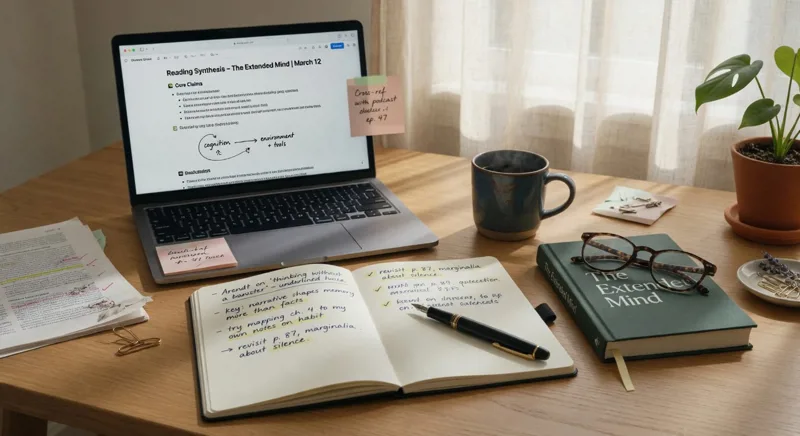
Most reading notes disappear into notebooks, apps, and forgotten documents. The reading notes you might actually revisit are different: brief, useful, written in your own words, and connected to questions you genuinely care about.
What Makes Reading Notes Worth Revisiting?
A good reading note does more than preserve a quotation. It helps you remember an idea, understand why it matters, and find it again when you need it. The most useful notes usually contain three elements:
- A clear idea: What is the author really saying?
- Your response: Do you agree, disagree, or see a limitation?
- A future use: Where might this idea help you think, write, study, or decide?
This approach turns passive reading into active learning. Instead of collecting impressive sentences, you build a practical knowledge system that can support essays, work projects, creative writing, research, and everyday decision-making.
Start With a Reading Question
Before opening a book or article, write down what you want to discover. A reading question gives your attention somewhere to go and makes note-taking more selective.
Useful questions include:
- What problem is this author trying to solve?
- What evidence supports the central argument?
- What assumptions does the author make?
- How does this idea connect to something I already know?
- What could I apply in real life?
You do not need a complicated reading notes template. One strong question can be more useful than several pages of copied highlights.
Write Notes in Your Own Words
Copied passages may look valuable, but they often create the illusion of understanding. Rewriting an idea forces you to process its meaning and reveals whether you truly understand it.
After finishing a section, close the book and write a short explanation from memory. Then check the original text for details you missed. This simple recall step makes your notes more useful for long-term learning than rereading alone.
A Simple Formula for Better Notes
Try this structure:
- Claim: State the main idea in one sentence.
- Reason: Explain why the author believes it.
- Example: Add a practical illustration.
- Response: Record your question, criticism, or connection.
For example, instead of writing, “People often confuse busyness with progress,” write: “The author argues that visible activity is not the same as meaningful progress. This connects to my habit of answering easy emails before doing difficult, important work.”
Keep Each Note Focused
The best permanent notes usually contain one main idea. A note that combines several unrelated concepts becomes difficult to scan and even harder to reuse.
Focused notes are easier to:
- Understand months or years later
- Link to related ideas
- Use in an article, presentation, or project
- Review through active recall
Give each note a specific title, such as “Small deadlines reduce decision fatigue” rather than “Chapter 4 notes.” The first title tells you what the note contains before you open it.
Separate Reading Notes From Permanent Notes
Not every thought deserves a permanent place in your knowledge system. It helps to separate temporary reading notes from refined notes you expect to use again.
| Note type | Purpose | Example |
|---|---|---|
| Fleeting note | Capture a quick thought or question | “This resembles the idea of delayed gratification.” |
| Literature note | Summarize a book, article, or chapter | “The author presents three causes of workplace distraction.” |
| Permanent note | Preserve one reusable idea | “Reducing available choices can make important work easier to start.” |
This prevents your note-taking app from becoming a storage bin. Capture freely while reading, then refine only the ideas that remain relevant.
Connect Notes to Other Ideas
A note becomes more valuable when it has context. Link it to related books, personal experiences, opposing arguments, or questions you want to explore.
Useful connections might show that two authors:
- Agree about the same principle
- Use different evidence to reach similar conclusions
- Disagree about causes or solutions
- Apply one idea to completely different fields
These connections transform isolated reading notes into a personal knowledge base. They also make future writing easier because you can follow a trail of related ideas instead of beginning with a blank page.
Use a Review Schedule You Can Maintain
A perfect note-taking system is useless if you never return to it. Keep review practical by choosing a small, repeatable schedule.
- Review new notes after finishing a chapter.
- Revisit important notes later in the week.
- Review connected ideas during a monthly planning session.
- Update or delete notes when your understanding changes.
Before rereading, test yourself. Ask, “What was the main argument?” or “What did this idea change about my thinking?” Retrieval makes review active and shows you which notes still matter.
Choose the Right Format for Your Reading
Different materials call for different note-taking methods. A novel may benefit from character observations and recurring themes. A textbook may need definitions, diagrams, and practice questions. A business book may be most useful when organized around decisions and applications.
For academic reading, record the thesis, evidence, methodology, and limitations. For online articles, save the central claim and your reaction rather than copying the entire page. For nonfiction books, summarize each chapter briefly, then create separate notes for ideas that deserve further thought.
Final Thoughts
The reading notes you might actually revisit are not the longest or most beautifully organized. They are the ones that answer a question, express an idea clearly, and show why it matters to you.
Write less, think more, and make every note easy to understand later. When your notes are focused, personal, connected, and periodically reviewed, reading becomes more than information collection—it becomes a growing library of ideas you can genuinely use.