How to Start a Study Group That Does More Than Chat
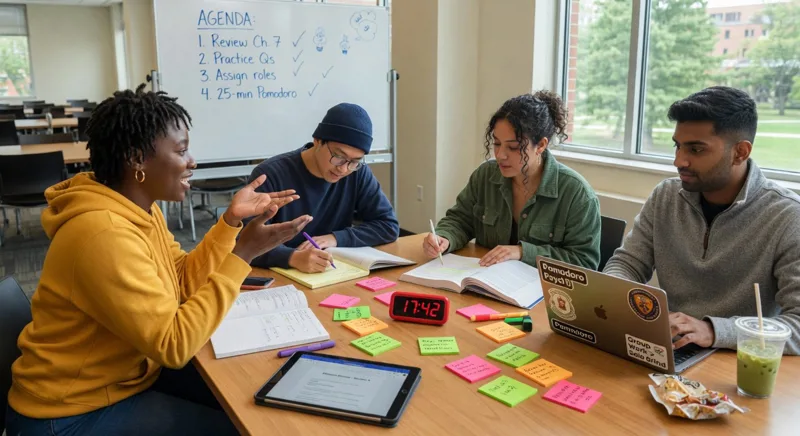
Learning with friends can be motivating—but without structure, a study group can quickly become a social hour. The key to learning together is simple: set a clear goal, use active study techniques, and give every member a meaningful role.
Why Some Study Groups Work—and Others Don’t
A productive study group is not just several people reading notes in the same room. It is a small learning team with a shared outcome, individual responsibility, and a plan for checking progress.
Research on collaborative learning highlights two essential ingredients: positive interdependence, where members need one another to succeed, and individual accountability, where each person must prepare and contribute.[1]
Without these elements, one person may dominate the conversation while others quietly listen. The group may feel busy without improving exam performance, knowledge retention, or critical thinking.
Choose the Right Study Group Members
Start with three to five students who are taking the same course or preparing for the same exam. This size is large enough to provide different perspectives but small enough for everyone to participate. Small-group research has identified groups of three to five as a practical structure for collaborative learning.[1]
Look for members who:
- Have similar academic goals and schedules
- Are willing to prepare before meetings
- Can explain ideas respectfully and clearly
- Are comfortable admitting when they do not understand something
- Will contribute consistently rather than attend only before exams
Perfectly identical skill levels are not required. A group with varied strengths can be helpful, provided stronger students do not become unpaid tutors and quieter members are invited to participate.
Set a Specific Study Group Goal
“Study chemistry” is too vague to guide a useful session. A stronger goal describes what members will be able to do by the end.
Try goals such as:
- Explain the stages of cellular respiration without using notes
- Solve ten calculus problems and identify common errors
- Compare two theories and defend which one best answers a prompt
- Create and complete a practice test for the next history exam
- Review five difficult vocabulary terms using retrieval practice
Use a shared document or simple study group planner to record the topic, preparation tasks, questions, and follow-up assignments. This prevents every meeting from beginning with, “What should we do today?”
Build a Repeatable Study Group Agenda
A consistent agenda makes meetings easier to organize and reduces unfocused conversation. A 60-minute session might look like this:
- Five minutes: Review the goal and assign roles.
- Ten minutes: Complete a no-notes warm-up quiz.
- Twenty minutes: Solve problems or discuss challenging concepts.
- Fifteen minutes: Teach one another using examples and explanations.
- Five minutes: Correct misunderstandings and record open questions.
- Five minutes: Assign preparation for the next meeting.
Rotate roles from week to week. A facilitator keeps the group on track, a question leader prepares discussion prompts, a checker verifies answers, and a recorder summarizes decisions and unresolved issues.
Use Active Learning Instead of Passive Review
Reading the same chapter together can create a false sense of progress. Replace passive review with activities that require members to retrieve, explain, apply, and evaluate information.
Retrieval practice
Close the textbook and ask everyone to write what they remember. Then compare answers and correct gaps. Flashcards, practice questions, blank-page summaries, and short quizzes all turn memory into an active process.
Peer teaching
Give each member a concept to explain in two or three minutes. The explanation should use plain language, an example, and a quick check for understanding. If someone cannot explain an idea clearly, that is useful information about what needs more study.
Problem-solving rounds
Choose a problem that requires reasoning rather than simple recall. Have members solve it independently first, then compare methods. Discuss not only the correct answer but also why alternative approaches failed.
Exam-question workshops
Bring questions from practice tests, lecture materials, or assigned readings. Ask the group to identify the command words, evidence required, likely misconceptions, and features of a strong answer.
Schedule Spaced Practice, Not Cramming
Effective study groups meet repeatedly instead of waiting until the night before an exam. Spaced practice distributes learning over time, and research indicates that spacing can improve recall compared with massed study sessions.[2]
For example, schedule three 60-minute meetings across two weeks:
- Meeting one: Learn the core concepts and identify weak areas.
- Meeting two: Complete retrieval practice and mixed problems.
- Meeting three: Simulate exam conditions and review mistakes.
Begin each meeting with a short quiz covering older material. This makes the group revisit information before it fades and reveals which topics require another explanation.
Create Rules That Prevent the Group from Drifting
Agree on simple group norms at the first meeting. Keep them practical and measurable:
- Arrive prepared with notes, questions, or assigned work completed.
- Keep phones away unless they are needed for the activity.
- Give everyone time to speak.
- Challenge ideas, not people.
- Record unanswered questions instead of guessing.
- End each meeting with a clear next step.
If conversation repeatedly drifts, return to the written goal. It can also help to use a timer for each activity and reserve informal conversation for the final few minutes.
Measure Whether Your Study Group Is Working
Attendance and enjoyable conversations are not enough to prove that a study group is effective. Use simple evidence to evaluate the process.
- Can members answer more questions without notes?
- Are mistakes becoming less frequent?
- Can each person explain difficult ideas independently?
- Are meetings producing completed practice work?
- Do members know exactly what to study next?
End each session with a one-minute reflection: “What can I now do that I could not do before?” and “What remains unclear?” These answers help the group adjust its study plan instead of repeating comfortable activities.
Final Takeaway
To start a study group that does more than chat, keep the team small, define a measurable goal, assign rotating roles, and focus on retrieval practice, peer teaching, problem-solving, and spaced review. The best study group is not the one that talks the most—it is the one that helps every member leave better prepared to think and work independently.