The Difference Between Finishing a Course and Learning a Skill
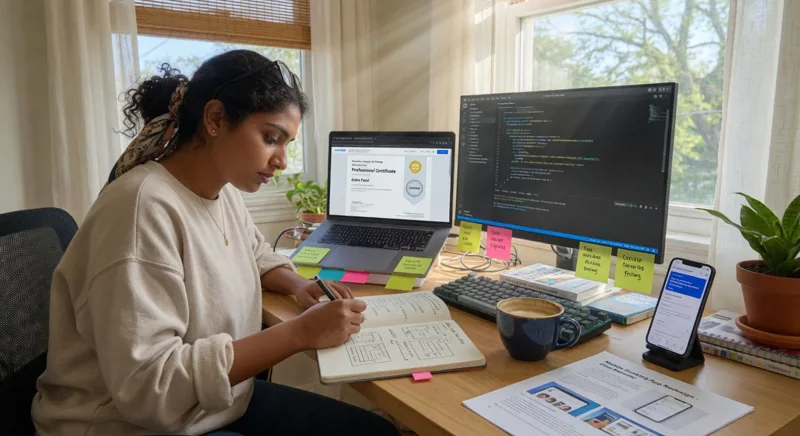
Finishing a course can give you information, a certificate, and a sense of progress. Learning a skill goes further: it means you can use that knowledge confidently in real situations. Understanding the difference between finishing a course and learning a skill can transform how you study, practice, and measure success.
What Does It Mean to Finish a Course?
Finishing a course usually means completing the required lessons, watching the videos, submitting assignments, and passing a final quiz or exam. It is a clear administrative milestone, but it does not always prove practical competence.
A completed course may show that you were exposed to important ideas. For example, a digital marketing course might explain search engine optimization, keyword research, content strategy, and analytics. However, exposure is not the same as being able to create and manage a successful SEO campaign.
Course completion is valuable because it can provide:
- A structured learning path
- Basic terminology and concepts
- Access to examples, instructors, and resources
- A record of participation or completion
- A foundation for continued professional development
The limitation is simple: a certificate often confirms that you completed the learning process, not that you can consistently perform the skill independently.
What Does It Mean to Learn a Skill?
Learning a skill means developing the ability to apply knowledge through action. A skilled person can make decisions, solve problems, adapt to unfamiliar situations, and produce a useful result without relying constantly on step-by-step instructions.
Consider learning Excel. Finishing an Excel course may teach you formulas, pivot tables, and charts. Learning the skill means using those tools to clean a messy dataset, identify trends, explain your findings, and build a report that helps someone make a decision.
Skill development usually includes four stages:
- Understanding: You learn the concepts, vocabulary, and basic methods.
- Guided practice: You follow examples while receiving support or feedback.
- Independent application: You complete realistic tasks without constant assistance.
- Adaptation: You use the skill effectively when circumstances change.
That final stage is often overlooked. Real competence is not merely repeating a demonstration. It is knowing what to do when the problem looks different from the example in the course.
Course Completion vs. Skill Mastery
| Course Completion | Skill Mastery |
|---|---|
| Measures whether lessons or requirements were completed | Measures whether knowledge can be applied effectively |
| Often focuses on quizzes and assignments | Focuses on performance, results, and problem-solving |
| May happen within a fixed timeframe | Develops through repeated practice over time |
| Can produce a certificate | Produces confidence and practical capability |
| Usually follows a predictable curriculum | Requires adapting to real-world situations |
Neither outcome is automatically better. A well-designed course can be the fastest way to build a foundation. The important distinction is that course completion is an event, while skill development is an ongoing process.
Why Watching Lessons Is Not Enough
Many learners experience the “illusion of competence.” A lesson feels easy to follow, so it feels as though the knowledge has been mastered. But recognizing an explanation is much easier than recalling and applying it independently.
Research on retrieval practice shows that actively recalling information improves retention and helps learners apply ideas in new contexts more effectively than simply rereading or restudying material.[1] This is why answering questions from memory, explaining a concept aloud, and completing practice tasks are more powerful than passively consuming content.
Practical skills also require feedback. Without feedback, you may repeat the same mistake until it becomes a habit. Deliberate practice and mastery-based learning have been associated with improved performance and reduced skill decay in professional education settings.[2]
How to Turn a Completed Course Into a Real Skill
1. Define a practical outcome
Do not stop at “complete a programming course” or “learn graphic design.” Set an observable goal, such as building a working website, creating a brand identity, or automating a repetitive task.
2. Practice without following the tutorial
After completing a lesson, close the course material and attempt the task from memory. This reveals what you actually understand and what you only recognized while watching.
3. Use realistic projects
Projects turn abstract knowledge into usable experience. Choose tasks that resemble the work you eventually want to perform, whether that involves writing, coding, bookkeeping, data analysis, public speaking, or project management.
4. Ask for specific feedback
General praise is less useful than targeted feedback. Ask what could be clearer, faster, more accurate, or more effective. Then revise your work and try again.
5. Space out your practice
Short, repeated practice sessions are usually more sustainable than one long study session. Spaced learning also gives you opportunities to test whether you can still perform the skill after time has passed.
6. Explain your decisions
Someone who has learned a skill should be able to explain not only what they did, but why they chose that approach. Teaching another person or writing a brief process guide can expose gaps in your understanding.
How to Measure Whether You Have Learned a Skill
A certificate is one measure, but it should not be the only one. Ask yourself:
- Can I complete a realistic task without step-by-step guidance?
- Can I explain the process clearly to another person?
- Can I identify and correct my own mistakes?
- Can I adapt the skill to a new situation?
- Can I produce a result that meets a real standard?
- Can I repeat the performance consistently?
If the answer is yes, you are moving beyond course completion and toward genuine competence.
The Bottom Line
The difference between finishing a course and learning a skill is the difference between completing information and demonstrating ability. A course can show you what to learn, but practice, feedback, retrieval, and real-world application determine whether the knowledge becomes useful.
Use courses as a starting point, not a finish line. Measure progress by what you can create, solve, explain, and improve independently. That mindset turns education from a checklist into lasting professional and personal growth.